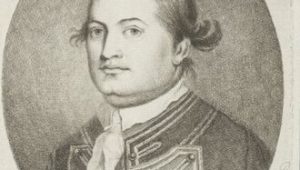
MAJOR GROSE IN CHARGE December 10th 1792 – Having long been in ill health and for this reason having begged relief from his duties, His Excellency Governor Arthur Phillip quitted his charge of the colony and embarked for England aboard Atlantic. The reins of Government are now in the hands of Lieut-Governor Major Grose, Commander of the N.S.W. Corps, who paid Governor Phillip the honours due to his rank as he boarded the vessel to take him home. Military power, hitherto considered requisite only Continue Reading »
SIR JOSEPH BANKS on BOTANY BAY

Joseph Banks, Esquire, when questioned, in case it should be thought expedient to establish a Colony of convicted Felons in any distant part of the globe, from whence their escape might be difficult, and where, from the fertility of the soil, they might be enabled to maintain themselves, after the first year, with little or no aid from the Mother Country, to give his opinion which place would be most eligible for such Settlement? The place which appeared to him most adapted for such a purpose Continue Reading »
Mary Bishop (née Davies/Davis)
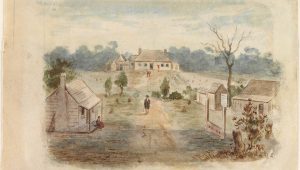
By John Heppell Mary Davis was born at Diddlebury, Shropshire, England. Her age as recorded in his journal by First Fleet Surgeon Arthur Bowes places her birth in about 1761 or ’62.[1] Assiduous review of the Diddlebury Parish registers reveals no baptism of a Mary Davies or Davis during that period, or for several years either side. However, there is one only Mary Davies to be found in that record, daughter of a Griffith and Ann Davies, who was baptised on 10th May 1752 in the Continue Reading »
Governor Phillip’s Foundation Plate, 15th May 1788

By Desmond (Des) Café First Government House Foundation Plate. The piece of copper plate that telegraph line worker Robert McCann uncovered in 1899 had been placed between the two sandstone blocks, 111 years earlier by Governor Arthur Phillip. On the 15th May 1788, Governor Phillip laid the foundation plate to mark the start of the building of Government House in Sydney Cove. Continue reading Gov. House Sydney Continue Reading »
THE WONDERFUL KANGAROO
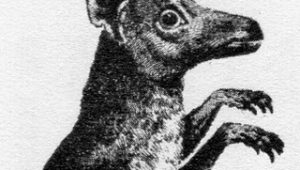
In 1791, a live Kangaroo, advertised on a Broadside Handbill, as The wonderful Kanguroo from Botany Bay, was exhibited for the first time in the Hay Market district of London. For an admittance fee of a shilling, the crowds could delight at what one reporter described as the most amazing, beautiful and tame animal from the Southern Hemisphere that almost surpasses belief. The Kangaroo was removed from the Hay Market, and was exhibited at the Lyceum in the Strand and advertised on a Continue Reading »
Letter from Governor Arthur Phillip
Contributor - Nicholas James Drogo Hodgkinson – Montagu.Letter from Governor Arthur Phillip to The Marquess of Lansdown, July 1788,Manuscript MLMSS 7241 Arthur Phillip was appointed first Governor of the colony of New South Wales on 12 October 1786. He was commander of the First Fleet which sailed from Spithead on 31 May 1787 and disembarked at Port Jackson, New South Wales, on 26 January 1788. In December 1792, Phillip returned to England, resigning his post as Governor on 23 Continue Reading »
THE ORIGINS OF GROG and the NAVY RUM RATION
By Anne Gibson. Grog had its beginning in the Royal Navy, perhaps specifically on 21 August 1740. Water carried onboard Navy vessels became stagnant during long voyages, beer was added to overcome the taste and make the water more palatable. After the conquest of Jamaica in 1655 rum became popular and replaced beer as the sailors’ daily ration. Their ration was twice daily, and the men were often times drunk due to stockpiling their rations. Admiral Edward Vernon, Continue Reading »
SYDNEY COVE MEDALLION

By Anne Gibson. In November 1788 Captain Phillip wrote to Sir Joseph Banks, who was President of the Royal Society, to inform him that he had found minerals and white clay in the area of Sydney Cove, following the settlement of Port Jackson in January 1788. He sent samples of these to Banks at the end of 1788. “Sunday 16th November 1788. Phillip dated his eleventh despatch to Lord Sydney, and wrote to Nepean, Stephens and Sir Joseph Banks. The letter to sir Joseph Banks was an inventory of Continue Reading »
THE FEMALE ORPHAN SCHOOL

By Anne Gibson. The need for a female orphanage and education of the children of the colony had become apparent in Sydney. When Philip Gidley King returned to New South Wales as Governor, he and Mrs. King perceived the need to establish a class for girls similar to the one he had founded on Norfolk Island. After discussion with the Reverend Richard Johnson, King wrote to the Duke of Portland setting out his plans for an Orphan School. A committee was formed consisting of Rev. Johnson, Continue Reading »
THE IMPORTANCE OF PARTNERSHIP

By Patricia Deering (Descendant of Mathew Everingham, William Roberts, Elizabeth Rhymes and Kezie Brown). During the early days of settlement in NSW self-sufficiency was the mark of success. But it was not achieved without commitment – a good sold partner/wife/husband. I have been ‘gob smacked’ by the challenges that my first and second fleet ancestors faced – particularly the women. They fulfilled multiple roles – as agricultural worker, homemaker, partner, mother, Continue Reading »
