
Saturday, 11th July 1789Peter White, the sailmaker in the Sirius, disappeared from Sydney Cove. Sunday, 12th July 1789Parties went out searching for Peter White without success. Monday, 13th July 1789The search for Peter White continued, both by land and by water. Guns were fired from the Sirius to direct him to the ship. Tuesday, 14th July 1789Parties were again out searching for Peter White. Captain John Hunter and Davis Collins, returning from an expedition toward the mountains, were Continue Reading »
JAMES KIRBY

Who could imagine that a wooden chest box belonging to First Fleeter, Private Marine James Kirby, would be on display in the Old Geelong Gaol Museum. Having travelled with him on the convict ship Alexander to Sydney Cove in 1788, it would later find its way to Victoria and eventually be donated to the Museum by a Kirby descendant. HM Prison Geelong was a maximum security, Australian prison located on the corner of Myers and Swanston Streets in Geelong, Victoria. The Geelong Gaol first Continue Reading »
CHILDREN OF THE FIRST FLEET

When the 11 ships of the First Fleet sailed from Portsmouth on 13 May 1787, there was many young people aboard shattered over six of the ships. Three convict’s children embarked on the First Fleet died on the voyage. Babies were born alive after sailing of two died before the voyage’s end, with births and deaths recorded in 1788. Most of the children of Marines left when the regiment sailed on the Gorgon in 1791. THE CHILDRENAbel/Tilley, William (1787 – 1788) - son of convict Continue Reading »
Mary Bishop (née Davies/Davis)
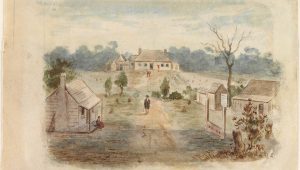
By John Heppell Mary Davis was born at Diddlebury, Shropshire, England. Her age as recorded in his journal by First Fleet Surgeon Arthur Bowes places her birth in about 1761 or ’62.[1] Assiduous review of the Diddlebury Parish registers reveals no baptism of a Mary Davies or Davis during that period, or for several years either side. However, there is one only Mary Davies to be found in that record, daughter of a Griffith and Ann Davies, who was baptised on 10th May 1752 in the Continue Reading »
Governor Phillip’s Foundation Plate, 15th May 1788

By Desmond (Des) Café First Government House Foundation Plate. The piece of copper plate that telegraph line worker Robert McCann uncovered in 1899 had been placed between the two sandstone blocks, 111 years earlier by Governor Arthur Phillip. On the 15th May 1788, Governor Phillip laid the foundation plate to mark the start of the building of Government House in Sydney Cove. Continue reading Gov. House Sydney Continue Reading »
THE WONDERFUL KANGAROO
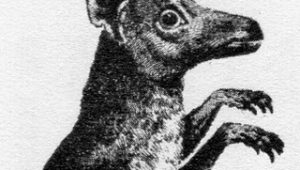
In 1791, a live Kangaroo, advertised on a Broadside Handbill, as The wonderful Kanguroo from Botany Bay, was exhibited for the first time in the Hay Market district of London. For an admittance fee of a shilling, the crowds could delight at what one reporter described as the most amazing, beautiful and tame animal from the Southern Hemisphere that almost surpasses belief. The Kangaroo was removed from the Hay Market, and was exhibited at the Lyceum in the Strand and advertised on a Continue Reading »
Letter from Governor Arthur Phillip
Contributor - Nicholas James Drogo Hodgkinson – Montagu.Letter from Governor Arthur Phillip to The Marquess of Lansdown, July 1788,Manuscript MLMSS 7241 Arthur Phillip was appointed first Governor of the colony of New South Wales on 12 October 1786. He was commander of the First Fleet which sailed from Spithead on 31 May 1787 and disembarked at Port Jackson, New South Wales, on 26 January 1788. In December 1792, Phillip returned to England, resigning his post as Governor on 23 Continue Reading »
THE ORIGINS OF GROG and the NAVY RUM RATION
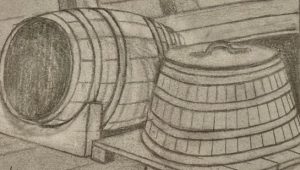
By Anne Gibson. Grog had its beginning in the Royal Navy, perhaps specifically on 21 August 1740. Water carried onboard Navy vessels became stagnant during long voyages, beer was added to overcome the taste and make the water more palatable. After the conquest of Jamaica in 1655 rum became popular and replaced beer as the sailors’ daily ration. Their ration was twice daily, and the men were often times drunk due to stockpiling their rations. Admiral Edward Vernon, Continue Reading »
EXTRACTS FROM THE DIARY OF WATKIN TENCH, A CAPTAIN OF THE MARINES

The Expedition to Port Jackson Our passage to Port Jackson took up but few hours and those were spent far from unpleasantly. The evening was bright and the prospect before us such as might justify sanguine expectation. Having passed between the capes which form its entrance, we found ourselves in a port superior in extent and excellency to all we had seen before. We continued to run up the harbour about four miles in a westerly direction, enjoying the luxuriant prospect of Continue Reading »
Colonial Vessel ‘Francis’

By Anne Gibson Tuesday 14 February 1792 … The signal was made for a sail, and shortly after the ‘Pitt’ Captain Edward Manning, anchored in the cove from England …, She had on board Francis Grose Esq the Lieutenant-Governor of the settlements, and Major-Commandant of the New South Wales corps, one company of which, together with the adjutant and surgeon’s mate, came out with him. She bought out three hundred and nineteen male and forty-nine female convicts, five children, and seven Continue Reading »
