Two men separated by class, one an Officer, the other a Convict, arrived into Sydney Cove as part of the First Fleet in 1788. Both men, left the colony and returned to England, in the 1790s.
Both returned in 1803, the Officer in-change of forming a settlement at Port Phillip (Sullivan Bay, near modern day Sorrento), Victoria and the Convict, as a free man, and settler. In 1804 they left Sullivan Bay, leading to its’ abandonment, for the Derwent (Hobart), Van Diemens’ Land (Tasmania). Both died in Hobart, and were buried in St David’s Park, Hobart.
The Officer was David Collins (1756 – 1810), captain of marines. He was a large broad- shouldered man, over six feet tail with golden curly hair. Collins already had years of service with the Marines, serving on many different naval ships in world conflicts, when on 24 October 1786, he was commissioned as deputy judge advocate of the proposed NSW settlement. He was aboard HMS Sirius when it arrived into Sydney Cove in January 1788. His responsibility for the colony’s legal affairs kept him extremely busy. He stayed in the colony longer than he needed to, out of loyalty to Governor Arthur Phillip, departing for England after John Hunter arrived as Governor.
The convict, was Samuel Lightfoot (c1763 -1818), who was tried at Devon Lent Assizes, held at Exeter Castle on Monday 14 March 1785, for burglariously breaking and entering the dwelling house of Samuel Creeby and Samuel Graves and stealing linen shirts, handkerchiefs and other goods. Found guilty of stealing the goods but not guilty of breaking and entering the house at night, he was sentenced to a term of 7 years transportation. Early in 1786, aged 22, he was received on the Dunkirk Hulk, behaving there remarkably well. On 11 March 1787 he was discharged to the Charlotte. Port Jackson 1788, Lightfoot was assigned to work in the laboratory tent and was involved as witness at the trial of three convicts for theft of wine from the hospital stores. The accused were acquitted and the documents signed by Judge Advocate David Collins. The Laboratory Tent was a structure pitched on the shores of Sydney Cove. Used by Surgeon John White and his medical staff, the tent served as a primitive apothecary and medical store for the fledgling colony’s hospital.
On 20 February 1794, Lighfoot was granted 30 acres of land on the north side of the harbour opposite Sydney Cove. There is no record that he developed the land, as shortly after he seems to have sold it. When his sentence had expired Samuel Lightfoot returned to England.
On his return to England, Samuel Lightfoot may have secured work in a local infirmary or apothecary owing to his time in the Sydney Cove’s Laboratory tent. We do not hear of Samuel Lightfoot again until a few years later.
Also back in England was David Collins, who wrote The Account of the English Colony in New South Wales, published in 1798 and 1802 and edited for a joint edition in 1804 by his wife Maria. In 1803, David Collins came out of retirement, when asked to lead an expedition to found the Port Phillip District, which would extend Britian’s interests in New Holland. It had previously been discovered that the southern extremity of the continent known as Van Diemens’ Land was in fact an island, and the strait between the two, was named Bass Strait, after the explorer George Bass. Further exploration logged two large bays in the strait’s northern shore making a survey and Port Phillip, named in honour of Governor Arthur Phillip, offered excellent anchorage.
The Australian Chronicle 1801-1810, Vol.1, No.3 recorded this historical event.
PORT PHILLIP SETTLEMENT PLANNED – CAPTAIN COLLINS IN CHARGE
The Home Government has approved the proposal for a new settlement to be set up in the port Philip district. Captain David Collins, who served as Judge-Advocate under Governor Phillip and departed the Colony for Home in 1796, has been appointed to lead an expedition from England to found the Port Phillip Settlement. His Excellency Governor King has urged settlement of Port Phillip since he received reports of Lieut. John Murray (HMS Lady Nelson) and Commander Matthew Flinders (HMS Investigator). Both officers, having examined the extensive bay on the southernmost coastline of New South Wales, declared it a suitable site for this purpose.
The Governor decided to name the place Port Phillip in honour of his former commander, the founder of the first settlement of Sydney Cove. Governor King is of the opinion that the establishment of the new settlement is made necessary by the activities of French explorers in these southern waters, carrying out what we are termed “scientific surveys of the New Holland coastline”. Possible foreign claims in these territories should be discouraged.
Samuel Lightfoot, liking the idea of the Port Phillip expedition, must have produced favourable witnesses to his character, when petitioning to be allowed to return to the colony as a free settler, with this wife. She did not arrive and is not recorded in any of the relevant documentation. Lightfoot’s petition was successful as he sailed aboard the Ocean.
Commanded by Captain Daniel Woodriff, HMS Calcutta sailed from Spithead, England, on 28 April 1803. On board Calcutta was Lieutenant Governor David Collins, the Reverend Knopwood, 308 convicts, marine personnel, civil-officers including some wives and children. Accompanying HMS Calcutta was the sailing ship Ocean with free settlers, plus some wives and children. The Ocean arrived at Port Phillip two days before the Calcutta in October 1803.
Difficulties arose with setting up a settlement in Port Phillip, with the scarcity of fresh water and poor soil, plus other factors. Lieutenant-Governor Collins decided to abandon the settlement. Ocean, in two journeys, relocated the settlers, convicts, and marines to the River Derwent, Van Diemens’ Land (Hobart) in February 1804. HMS Calcutta had left shortly after the landing of convicts, personnel and provisions at Port Phillip. Ocean was released from service with His Majesty’s government after moving Collins’s settlers and marines to Hobart. She sailed to Port Jackson and was there by 26 August 1804.
David Collins was the Lieutenant-Governor of Hobart Town for six years. He faced difficult times with rebellious convicts, quarrelsome marines and unskilled settlers, with poor equipment and little encouragement from home. He must be regarded however, as the most talented and prominent man connected with the foundation and the early history of Australia.
Death of Capt. D. Collins
Captain David Collins, Lieut-Governor Van Diemen’s Land, had died suddenly at Hobart on March 24th 1810, aged 54 years. He was the first Judge Advocate of New South Wales, led the first settlement of Port Phillip, and later moved it to Hobart. The Administration is at Present in the hands of Lieut. Lord. (Australian Chronicle 1801-1810 Vol.1: No.3)
Although there was no provision on the civilian establishment for a hospital attendant, Collins would have need to rely on someone to take charge of the stores and direct convicts detailed for duty. He would have remembered Samuel Lightfoot from earlier days and knew he would be useful in such work. Lighfoot was subsequently appointed supervisor of the hospital in Hobart Town. He was an overseer at Hobart in 1810 and an assistant at Hobart’s general hospital in 1812. He died suddenly at Hobart on 17 May 1818, and was buried in St David’s Hobart Cemetery.
The Hobart Town Gazette and Southern Reporter (Tas: 1816-1821) Saturday 23 May 1818
DIED, – Suddenly, on Sunday morning last, in his 65th year, Mr Samuel Lightfoot, many years assistant at the General Hospital. He came to this Settlement with the late Lieutenant Governor Collins, and was generally respected by all who knew him. As the deceased was in perfect health the evening before he died, a Coroner’s Jury was of course summoned on the occasion, which returned a verdict – Died by the visitation of God.
When David Collins died on March 24, 1810, he was buried in St David’s Cemetery, where a monument was erected to his memory by Sir John Franklin in 1838. The monument is still standing. There is no lasing monument to Samuel Lightfoot.
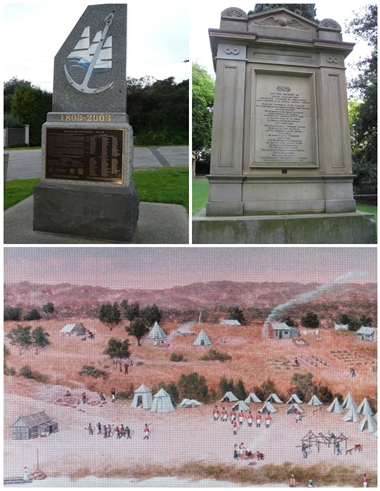
Photos – 1803-1840 Settlers Monument : Collins memorial St Davids Park, Hobart, Tasmania and artist impression Collins settlement Sullivan’s Bay, Sorrento Victoria
References:
Cobley John, The Crimes of the First Fleet Convicts
Cobley John, Sydney Cove 1788 – The first year of the Settlement of Australia
Tipping Marjorie, Convicts Unbounded, The Story of the Calcutta Convicts and their Settlement in Australia (1988)
Gillen Mollie, The Founders of Australia: A Biographical Dictionary of the First Fleet (1989)
Wikepedia
