
Who could imagine that a wooden chest box belonging to First Fleeter, Private Marine James Kirby, would be on display in the Old Geelong Gaol Museum. Having travelled with him on the convict ship Alexander to Sydney Cove in 1788, it would later find its way to Victoria and eventually be donated to the Museum by a Kirby descendant. HM Prison Geelong was a maximum security, Australian prison located on the corner of Myers and Swanston Streets in Geelong, Victoria. The Geelong Gaol first Continue Reading »
THE FEMALE ORPHAN SCHOOL

By Anne Gibson. The need for a female orphanage and education of the children of the colony had become apparent in Sydney. When Philip Gidley King returned to New South Wales as Governor, he and Mrs. King perceived the need to establish a class for girls similar to the one he had founded on Norfolk Island. After discussion with the Reverend Richard Johnson, King wrote to the Duke of Portland setting out his plans for an Orphan School. A committee was formed consisting of Rev. Continue Reading »
JOHN CAESAR – THE ESCAPING CONVICT

By Lord Nicholas Hodgkinson John Ceasar (known as Black Caesar) was a convict who came out on the transport ship Alexander. He was tried and convicted for stealing 240 shillings from a dwelling house and was sentenced to transportation for seven years. During those seven years he was notorious in his behaviour, often stealing. On 29 April 1789 Caesar was tried in the colony for theft and sentenced a second time, this time, to a life sentence. He escaped a Continue Reading »
PHEBE/PHOEBE FLARTY

By Ann Gibson ADVENTURES OF A FIRST FLEET LASS Saturday, 7th June 1788Phebe Flarty was charged on the suspicion of making away with 2 pairs of stockings, I pair of shoes, 1 waistcoat, 1 new shirt, 1 pair of trousers, and 1 silk handkerchief, the property of John Romain. Ann Smith and Phebe Flarty gave evidence. Romain said that he had given the articles to Ann Smith to take care of for him. On Wednesday the 4th Phebe Flarty was very much in liquor and had to be put to bed by Continue Reading »
CHILDREN OF THE FIRST FLEET

When the 11 ships of the First Fleet sailed from Portsmouth on 13 May 1787, there was many young people aboard shattered over six of the ships. Three convict’s children embarked on the First Fleet died on the voyage. Babies were born alive after sailing of two died before the voyage’s end, with births and deaths recorded in 1788. Most of the children of Marines left when the regiment sailed on the Gorgon in 1791. THE CHILDRENAbel/Tilley, William (1787 – 1788) - son of convict Continue Reading »
Mary Bishop (née Davies/Davis)
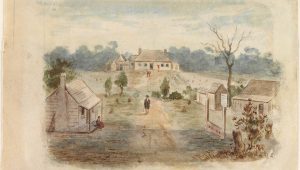
By John Heppell Mary Davis was born at Diddlebury, Shropshire, England. Her age as recorded in his journal by First Fleet Surgeon Arthur Bowes places her birth in about 1761 or ’62.[1] Assiduous review of the Diddlebury Parish registers reveals no baptism of a Mary Davies or Davis during that period, or for several years either side. However, there is one only Mary Davies to be found in that record, daughter of a Griffith and Ann Davies, who was baptised on 10th May 1752 in the Continue Reading »
THE IMPORTANCE OF PARTNERSHIP

By Patricia Deering (Descendant of Mathew Everingham, William Roberts, Elizabeth Rhymes and Kezie Brown). During the early days of settlement in NSW self-sufficiency was the mark of success. But it was not achieved without commitment – a good sold partner/wife/husband. I have been ‘gob smacked’ by the challenges that my first and second fleet ancestors faced – particularly the women. They fulfilled multiple roles – as agricultural worker, homemaker, partner, mother, Continue Reading »
Colonial Vessel ‘Francis’

By Anne Gibson Tuesday 14 February 1792 … The signal was made for a sail, and shortly after the ‘Pitt’ Captain Edward Manning, anchored in the cove from England …, She had on board Francis Grose Esq the Lieutenant-Governor of the settlements, and Major-Commandant of the New South Wales corps, one company of which, together with the adjutant and surgeon’s mate, came out with him. She bought out three hundred and nineteen male and forty-nine female convicts, five children, and seven Continue Reading »
FIRST FLEET CONVICT CLAIMS DISCOVERY OF A GOLDMINE

During August 1788 convict James Daley reported the discovery of a piece of ground where he had found a quantity of yellow coloured ore which did appear to contain gold. The Governor was absent from Port Jackson at the time and Daley refused to name the location until he returned when he, Daley, would give a full account of the discovery if the Governor would grant him compensation for the find. A boat was ordered from Sirius to carry Daley and Captain Campbell, a corporal and two or three Continue Reading »
LETTER FROM A FEMALE CONVICT

Port Jackson, 14th November, 1788 I take the first opportunity that has been given us to acquaint you with our disconsolate situation in this solitary waste of the creation. Our passage, you may have heard by the first ships, was tolerably favourable; but the inconveniences since suffered for want of shelter, bedding, &c., are not to be imagined by any stranger. However, we have now two streets, if four rows of the most miserable huts you can possibly conceive of deserve that Continue Reading »
