Who could imagine that a wooden chest box belonging to First Fleeter, Private Marine James Kirby, would be on display in the Old Geelong Gaol Museum. Having travelled with him on the convict ship Alexander to Sydney Cove in 1788, it would later find its way to Victoria and eventually be donated to the Museum by a Kirby descendant.
HM Prison Geelong was a maximum security, Australian prison located on the corner of Myers and Swanston Streets in Geelong, Victoria. The Geelong Gaol first opened its doors in 1853 and ran continuously until 1991 when the gates closed behind the final prisoner. It was Victoria’s longest-running colonial Gaol. Today it houses an extensive museum showcasing the history of colonial crime and punishment in Victorians goals, along with experiences on the conditions of an 1850s colonial prison and the Kirby wooden chest box. Alongside the box, in the glass cabinet, is a model dressed in a marine costume. On loan from the Fellowship, it was worn by a member to all the Fellowship’s costumed events.
CONTENTS OF THE BOX
Each marine on the First Fleet was allocated a personal wooden chest to store essential items, personal belongings, and tools needed for their role in establishing the colony and supporting their duties.
UNIFORMS
The marines wore standard issue red coats, wool breeches, and black hats, which were part of their formal uniforms. These uniforms symbolized authority and discipline, both crucial for maintaining order among the convicts and settlers in the new colony.
CLOTHING
In addition to their uniforms, marines brought extra personal clothing such as stockings, shorts, and sturdy shoes. These items were needed to endure the long voyage and to have some spare clothing for the early days of settlement, as there was limited opportunity to acquire new garments.
PERSONAL ITEMS
Many marines packed personal mementos, like letters from loved ones, small keepsakes, and religious items, which offered comfort and a connection to home. Some marines also brought books, which might have included religious texts or other reading material.
WRITING MATERIALS
Writing was a common practice among marines, as some kept journals or wrote letters. Paper, ink, and quills were essential for recording experiences, communicating with others, and maintaining a sense of personal history and reflection.
This wooden chest belonged to marine James Kirby for his personal items which was one of the few constants that connected marines to their previous lives in Britain, providing both practical and sentimental support as they adapted to the harsh and unfamiliar environment of Australia.
(Old Geelong Gaol Museum)
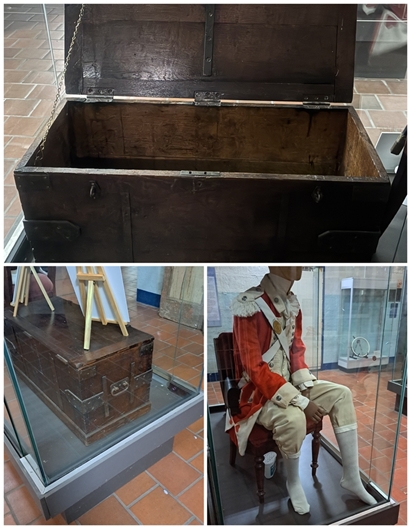
Marine James Kirby’s wooden chest box and replica Marine Uniform
JAMES KIRBY
Arrived into Sydney Cove by the convict transport, Alexander. He was a Private Marine 5th (Portsmouth Company) serving at Port Jackson in the company of Captain Shea. On 1 March 1790 he said he would become a settler if the terms offered were satisfactory. 3 days later he was sent by Supply to Norfolk Island. There on 24 February 1792 he was granted 60 acres of land on the Island, but in September of that year he was transferred back to Sydney, by Atlantic to join the NSW Corps. At the end of his service, Kirby received a grant of 200 acres at Mulgrave Place on 18 August 1799. By mid Kirby had three acres in wheat and three been ready for maize. He was off store with a woman and two children : a comment notes that he had no stock, was a former marine, and raised a query as to why he was not victualled.
Kirby’s partner and wife of their son, James Victor and daughter Elizabeth, was Mary Bond, sentenced to 7 years transportation. Bond had left children behind when transported on the 2nd Fleet transport Neptune, possibly with her last child born in Gaol. Elizabeth, who appears in the 1811 muster is believed to have become ward of Jonathan Griffiths (Scarborough 1790). He purchased Kirby’s farm and later gave Elizabeth land. From them on, information is sketchy. The burial of a James Kirby, free, aged given as 62 was recorded at St Phillip’s Sydney on 17 November 1820. Whether or not this man was the First Fleeter has not been established.
References:
Gillen, Mollie The Founders of Australia
Flynn, Michael, The Second Fleet
Wikepedia on-line
Old Geelong Gaol Museum
