Joseph Banks, Esquire, when questioned, in case it should be thought expedient to establish a Colony of convicted Felons in any distant part of the globe, from whence their escape might be difficult, and where, from the fertility of the soil, they might be enabled to maintain themselves, after the first year, with little or no aid from the Mother Country, to give his opinion which place would be most eligible for such Settlement?
The place which appeared to him most adapted for such a purpose was Botany Bay, on the coast of New Holland, in the Indian Ocean, which was about seven months voyage from England; that he apprehended there would be little probability of any opposition from the natives, as during his stay there, in the year 1770, he saw very few, and did not think there were above fifty in all the neighbourhood. Those he saw were naked, treacherous, and armed with lances, but extremely cowardly.
The proportion of rich soil was small in comparison to the barren, but sufficient to support a very large number of people. He observed the dung of what were called kangourous, which were about the size of a middling sheep, but very swift and difficult to catch. There were no beasts of prey, and he did not doubt but our oxen and sheep, if carried there, would thrive and increase; there was great plenty of fish. The grass was long and luxuriant, and there were some eatable vegetables; the country was well supplied with water, there was abundance of timber and fuel, sufficient for any number of buildings which might be found necessary.
Whether he conceived the Mother Country was likely to reap any benefit from a Colony established in Botany Bay he replied, ‘If the people formed among themselves a Civil government, they would necessarily increase, and find occasion for many European commodities; and it was not to be doubted, that a tract of land such as New Holland, which was larger than the whole of Europe, would furnish matter of advantageous return.
Evidence of Sir Joseph Banks,
Before a House of Commons committee,
Journals of the House of Commons, Vol. XXXVII , p.311.
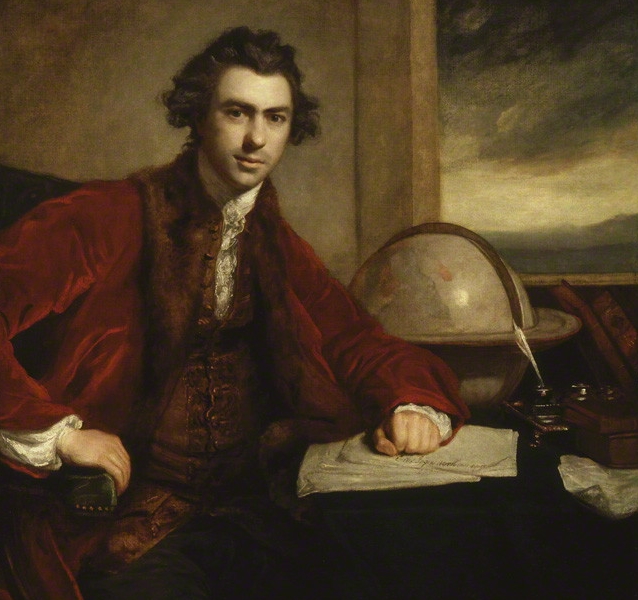
Joseph Banks, 1773, by Joshua Reynolds
Sir Joseph Banks, Scientist, Explorer, Botanist
Born 24 February 1743, Argyll Street, London, United Kingdom
Died 14 June 1820, in Spring Grove House, Isleworth, London, United Kingdom, and was buried at St Leonard’s Church, Heston.
Further reading: Wikipedia
